
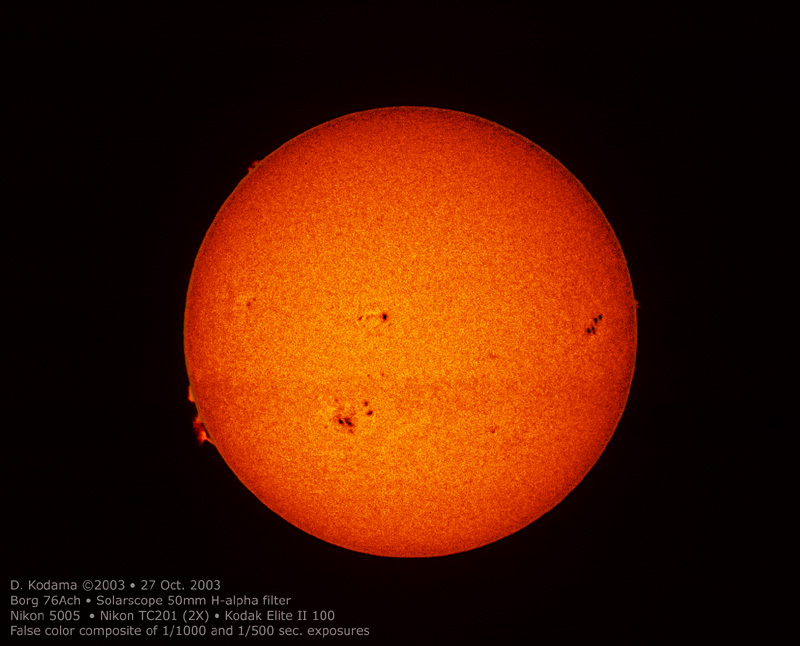
This shot shows the sun with an unusual amount of activity for a post-peak solar cycle period. The activity was associated with a large coronal mass ejection (CME). This was large enough to create auroral activity which was visible farther south than is normal for auroral displays.
This is a first attempt at shooting an H-alpha image of the sun as well as a first attempt at creating a false-color composite result. The filter used was a 0.7 angstrom wide H-alpha filter from Solarscope. This is a 50mm aperture obstructionless filter which was mounted on a Borg 76mm achromat refractor. Strictly speaking, this image is also unfortunately filtered by the smoke of numerous brush fires currently burning in Southern California.
The composite was created by combining a 1/1000 sec. exposure for the disk details, and a 1/500 sec. exposure for the prominences, both shot on Kodak Elite II 100 slide film. A Nikon 5005 body with a TC201 2X teleconverter was used to increase the system focal length to 1280mm.
Since H-alpha light is a pure red, which is hard to see on a monitor, the red channel was copied into the green channel and mixed to create an easier-to-see false-color image. All processing was done in Photoshop.
Note: The horizontal band is a scanner artifact.