
One of the areas I am most often asked about in regards to astrophotography is about the equipment I use and what I recommend. A recommendation is difficult because it depends on what kind of pictures one likes to take. The search for the best equipment setup might be likened to a wandering journey with your experience measured by the number of side-roads you have detoured into. What follows is not so much a recommendation of equipment as a chronology of where I've been and where I am now. If you can use it as a guide to shorten your journey, that would be satisfying to me and probably save you a fair amount of money!
I can roughly break my journey into 3 phases. If you're interested in the early days (older equipment), you can detour into reading about Phases I & II. These days, about the only older scope I still use on a regular basis is the Celestron C11. Its aperture is a big advantage for looking at dim objects, and it can't be matched for showing visitors closeup views of planetary nebulae or the planets. I'm still using the G11 mount part of the CG-11 package on a regular basis as described below. Its flexibility has really paid off well.
Phase III (the new millennium)
My current "phase" started in 2000 when I found out about the Japanese Borg refractor line of telescopes which were only just being introduced to the U.S. market. These scopes are optically of high quality, very configurable, and with many photographic accessories, so this was ideal to me! A bonus is that the larger scopes are designed from the beginning to accommodate medium format photography -- they include 4" focusers, a wide, flat image field, and a wide variety of flatteners, reducers, and teleconverters to choose from.
 The configuration I ended up with is pictured at
left. I am using the Series 115 Borg 100ED (100mm
objective) scope with the F6.4/F4 combo photo option.
This consists basically of the large diameter (115mm)
tube and 4" focuser. For photography at F6.4, the
longer tube section and 2-element "multi-flattener"
is used, and via a Pentax 67 coupling, I can use
either my Pentax 67 body or a Planet Town (a Japanese
brand) vacuum-back astro camera. Both cameras
produce a 6x7 frame which is roughly 4 times larger
in area than the familiar 35mm film frame. In the
photo at left, the STV autoguider is attached to the
Borg 76ED, but the camera is not attached to the main
scope. Instead a 2" eyepiece adapter is mounted for
use in drift alignment fine-tuning of the polar axis.
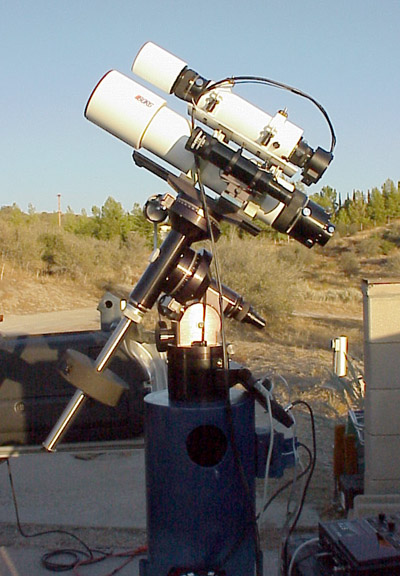
The configuration I ended up with is pictured at
left. I am using the Series 115 Borg 100ED (100mm
objective) scope with the F6.4/F4 combo photo option.
This consists basically of the large diameter (115mm)
tube and 4" focuser. For photography at F6.4, the
longer tube section and 2-element "multi-flattener"
is used, and via a Pentax 67 coupling, I can use
either my Pentax 67 body or a Planet Town (a Japanese
brand) vacuum-back astro camera. Both cameras
produce a 6x7 frame which is roughly 4 times larger
in area than the familiar 35mm film frame. In the
photo at left, the STV autoguider is attached to the
Borg 76ED, but the camera is not attached to the main
scope. Instead a 2" eyepiece adapter is mounted for
use in drift alignment fine-tuning of the polar axis.
In F4 configuration, the Borg 100ED must be switched to a shorter center tube and a 4-element "super-reducer" reducer-flattener is used on the back end. For this configuration, I use only the Planet Town camera back with a special coupling (wider than the Pentax bayonet) to avoid constricting the image size. The Planet Town's vacuum back is also necessary to hold the film completely flat. Buckling of the film causes out-of-focus areas in the image to be obvious when shooting at F4. Shooting at F4 also requires the optional large hood up front to avoid vignetting. Although not required for shooting at F6.4, I leave it on all the time.
Below, both configurations are shown packed in the optional case I purchased from Hutech for Borg scopes. The foam is cubed foam in this case model. I configured it so that I could carry pieces for both scope configurations at all times, but leave the scope assembled in either configuration for convenience.
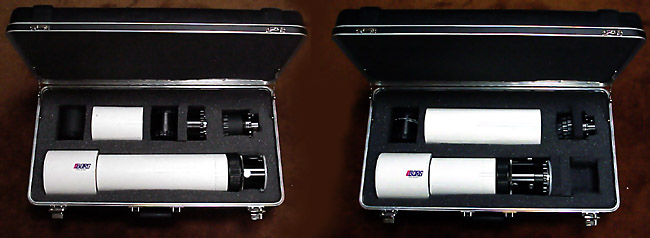
Borg 100ED F6.4 assembled configuration in case at
left and F4 configuration at right.
As part of my phase III journey, I converted to using an autoguider. I chose the just-released STV for its high sensitivity and built-in display, making it unnecessary to bring a computer out into the field. The built-in display is very helpful in acquiring guidestars, focusing, troubleshooting, and has the additional bonus of allowing me to manually guide on comets without having to be looking through a guiding eyepiece.
 For a guide scope, I am using a Borg 76ED which sits
on top of the main scope. I am using an optional
"front focus" setup which moves the focuser up front
near the objective lens. This improves the balance
of the overall setup as well as provides the stiffest
possible coupling between the scope and the
autoguider's CCD head. I found that the weight and
stiffness of the cable connection to the head can
cause a flexure problem in a typical coupling to a
guide scope, so I opted to fix the problem before it
could occur.
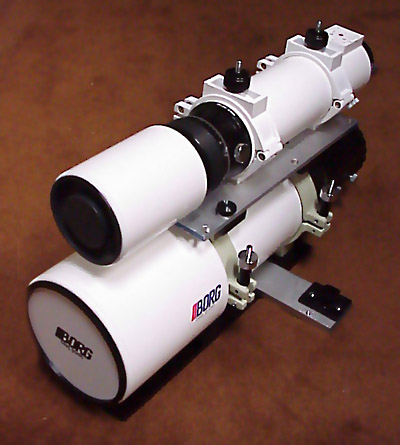
For a guide scope, I am using a Borg 76ED which sits
on top of the main scope. I am using an optional
"front focus" setup which moves the focuser up front
near the objective lens. This improves the balance
of the overall setup as well as provides the stiffest
possible coupling between the scope and the
autoguider's CCD head. I found that the weight and
stiffness of the cable connection to the head can
cause a flexure problem in a typical coupling to a
guide scope, so I opted to fix the problem before it
could occur.
The guide scope sits in non-adjustable Borg rings for maximum stiffness. The rings are screwed into a custom plate which has over-sized holes for connection to the main scope's rings. This gives some measure of side-to-side adjustment for guide star acquisition, though even this little extra flexibility is normally not used due to the sensitivity of the STV autoguider.
Note: The bracket extending out to the side of the main scope holds a finder subassembly which includes a Celestron 8x50 finder and Daisy "red dot" pointer. This subassembly is used both here and on my C11 tube.
It turns out that the Borg 76ED is not only lighter, but also optically outperforms the Televue Pronto I had previously used for a guidescope. Side-by-side viewing shows a slight violet halo of chromatic aberration around bright stars or at the edge of the moon in Pronto images, and none in the Borg 76ED. The light weight and ability to disassemble into small pieces has also made it my travel scope. I've even tried my hand at some daytime bird photography. As you might guess, I'm very satisfied with this scope and happy with its versatility.
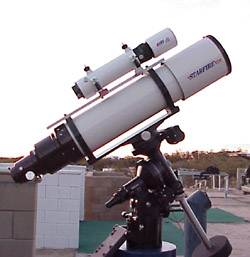 Just prior to acquiring the Borg scopes, I had an
opportunity to pick up a used Astro Physics 155mm F7
refractor, shown here at left with the Borg 76ED guidescope
on top. The hoods of both scopes are retracted in
this photo, and the autoguider and cameras are not
mounted, so the setup looks deceptively compact.
Just prior to acquiring the Borg scopes, I had an
opportunity to pick up a used Astro Physics 155mm F7
refractor, shown here at left with the Borg 76ED guidescope
on top. The hoods of both scopes are retracted in
this photo, and the autoguider and cameras are not
mounted, so the setup looks deceptively compact.
Experienced amateurs know that in the refractor world, AP scopes are highly regarded and that the waiting time to acquire one of these scopes is 10+ years (jokes are made about passing one's place in line to their eldest son). For me, using the scope is like (I imagine) driving a Rolls-Royce around -- very nice, but intimidating. This scope was originally purchased (used) with a 2.7" focuser, which I found vignettes even a 6x7 frame. In addition, the older field flattener lens suffered from internal reflections on bright stars. But fortunately I was later able to trade up to a 4" focuser and flattener, which took care of both the vignetting and internal reflection problem.
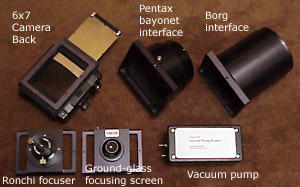
Part of my move to medium format photography was to acquire a vacuum back astrocamera. The components of the system are shown at right. As mentioned above, the vacuum back is essential for holding medium format film flat during the exposure or out-of-focus areas will result from the film bowing off the back plate. Because of the need for direct contact between the film and vacuum plate, if 120 film is used, the paper backing must be removed as described on the Hutech web site. 220 film can be used as-is since it does not include any backing paper.
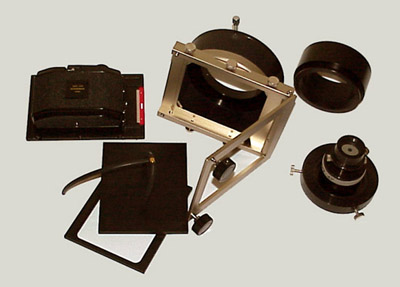 My latest camera acquisition is a combo 6x9cm
and 4x5" Mitsuboshi camera system for the Borg 100ED,
which is one of the few scopes that can come close to
utilizing the 4x5 frame.
My latest camera acquisition is a combo 6x9cm
and 4x5" Mitsuboshi camera system for the Borg 100ED,
which is one of the few scopes that can come close to
utilizing the 4x5 frame.
And to answer a commonly asked question (why am I still shooting film?) -- the short answer is that I find it fun and challenging. When appropriate, I shoot digital video and digital stills (using a Nikon D700 full-frame DSLR). I'm reserving conversion to going all digital for the time when the sensors get large and cheap and/or my film stock runs out.
All of my configurations, whether C11, AP, or Borg, sit on the versatile original Losmandy G11 mount (from my phase II), now updated with Losmandy's Gemini Go-To electronics and DC servo motors. The Go-To system has proven to be very convenient for centering on visually invisible targets and is more accurate than digital setting circles. More important, the versatile, standardized dovetail system and lots of accessories have made it possible for the mount to adapt to my changing setups.
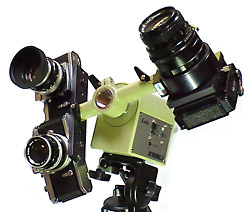 The only other change I have made with regards to
mounting was to acquire a Kenko tracker for
wide-field / portable photography. I've used this
tracker to hold as many as two Nikon 35mm cameras and my
Pentax 67 or Planet Town 6x7 vacuum camera
simultaneously for meteor photography. This compact
unit is also excellent for traveling when you can't
take something as big or heavy as a GM8 or G-11
mount.
The only other change I have made with regards to
mounting was to acquire a Kenko tracker for
wide-field / portable photography. I've used this
tracker to hold as many as two Nikon 35mm cameras and my
Pentax 67 or Planet Town 6x7 vacuum camera
simultaneously for meteor photography. This compact
unit is also excellent for traveling when you can't
take something as big or heavy as a GM8 or G-11
mount.